What Are Planetary Transits and How Do They Affect Your Daily Life
What Are Planetary Transits and How Do They Affect Your Daily Life
Have you ever noticed that certain weeks flow effortlessly while others feel like an uphill battle for no apparent reason? Astrology has a fascinating explanation: planetary transits. These celestial movements are the most powerful tool in predictive astrology and the key to understanding the cycles of change, opportunity, and challenge we experience throughout life.
In this article, we'll clearly explain what planetary transits are, how they work in relation to your birth chart, which ones matter most, and how artificial intelligence is revolutionizing the way we interpret them.
What Exactly Are Planetary Transits?
Planetary transits refer to the current positions of the planets in the sky compared to the positions they occupied at the moment of your birth, that is, compared to your natal chart.
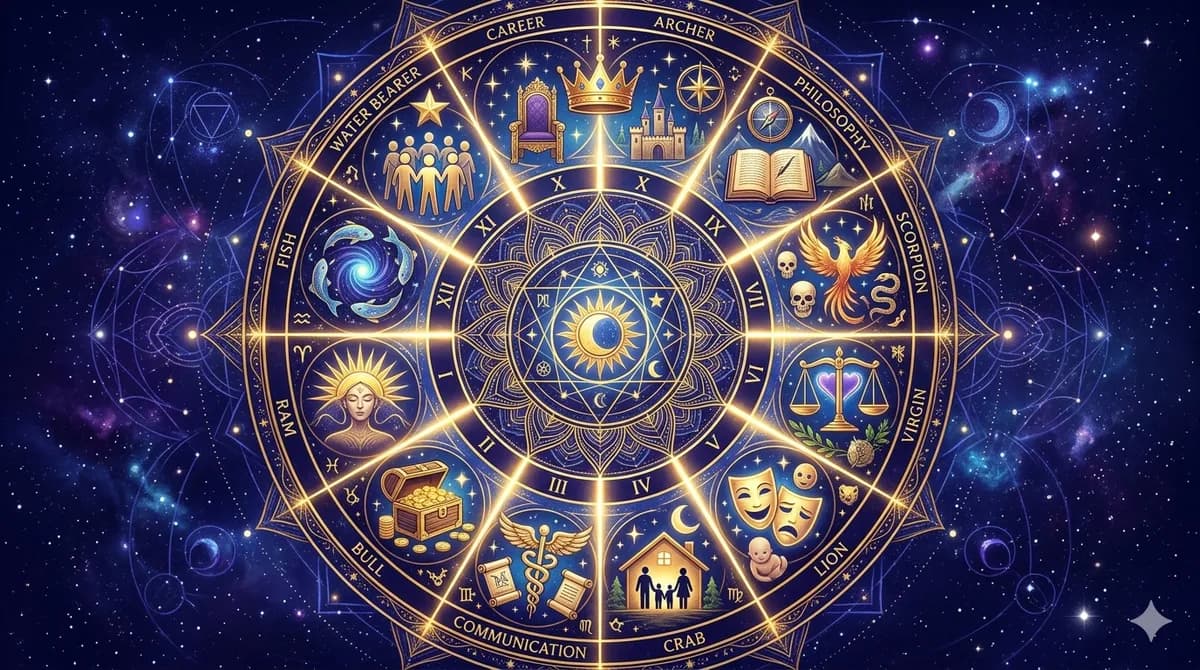
Think of your natal chart as a fixed photograph of the sky at the instant you were born. That photograph never changes: your natal planets are always in the same degrees and signs. However, the actual planets keep moving constantly through the zodiac. When a transiting planet forms a significant angle (an aspect) with one of your natal planets, a specific energy is activated in your life.
For example, if you were born with Venus at 15 degrees of Taurus and transiting Mars passes through 15 degrees of Scorpio, Mars is making an opposition to your natal Venus. This could manifest as relationship tension, intense passion, or conflicts over values and money.
Transits aren't isolated events: they are dynamic cycles that reflect the opportunities and challenges the universe presents at any given moment.
The Aspects: The Language of Transits
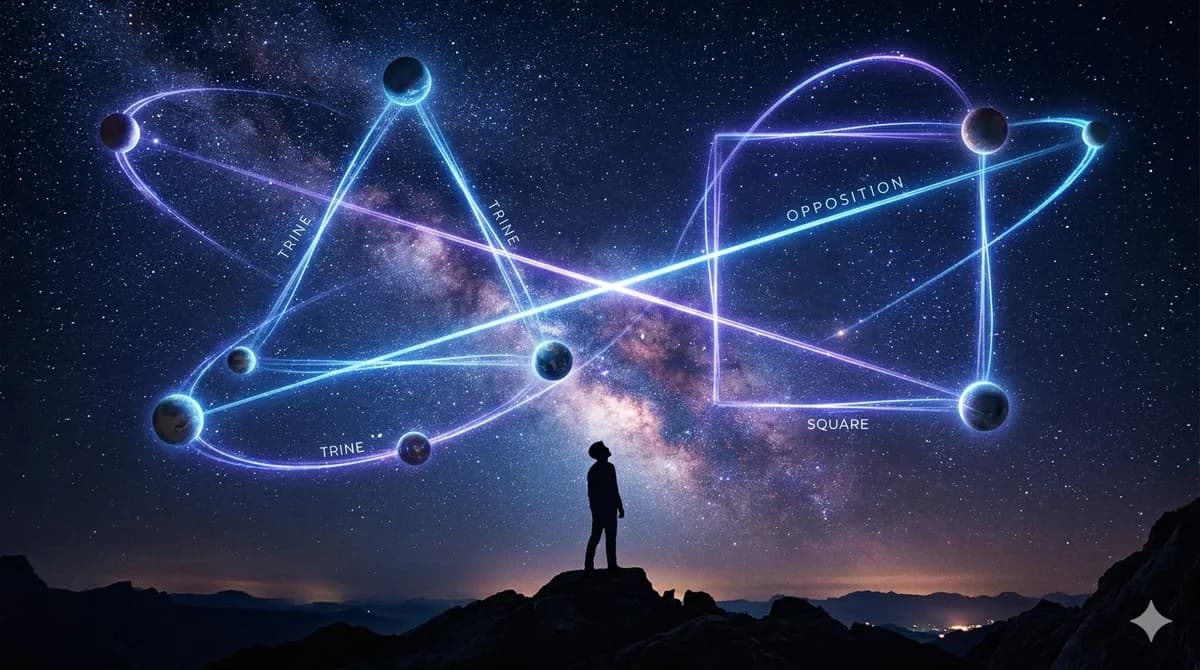
Not all transits feel the same. How a transiting planet interacts with your natal chart depends on the type of aspect it forms. Here are the main ones:
Conjunction (0°)
A conjunction occurs when a transiting planet places itself exactly on top of one of your natal planets, at the same degree and sign. It's the most powerful aspect because it fuses the energies of both planets. It can be intensely positive or challenging, depending on the planets involved.
- Example: Jupiter conjunct your natal Sun typically brings expansion, confidence, and important opportunities.
- Example: Saturn conjunct your natal Moon can generate a period of emotional seriousness and restructuring at home.
Trine (120°)
The trine is the most harmonious and flowing aspect. It connects planets in signs of the same element (fire with fire, earth with earth). Energy flows naturally, bringing talents, ease, and good fortune.
- Example: Venus trine your natal Jupiter is one of the most fortunate transits for love and money.
Sextile (60°)
Similar to the trine but less intense, the sextile offers opportunities that require action. They don't fall from the sky: you need to take initiative to seize them.
- Example: Mercury sextile your natal Mars favors assertive communication and negotiations.
Square (90°)
The square generates tension, friction, and pressure to act. Although uncomfortable, it's one of the most productive aspects because it pushes us out of our comfort zone and toward growth.
- Example: Mars square your natal Saturn can create frustration but also the determination to overcome obstacles.
Opposition (180°)
The opposition creates a dynamic of polarity and confrontation. It usually manifests through other people or external situations that force us to seek balance.
- Example: Pluto opposing your natal Venus can bring transformative relationships that challenge your deepest values.
Fast Transits vs. Slow Transits
Not all transits have the same duration or impact. The distinction between fast and slow planets is fundamental to understanding which transits deserve the most attention.
Fast Planets (Personal)
- Moon: Changes signs every 2.5 days. Its transits affect daily mood and emotions.
- Mercury: Moves through a sign in 2-3 weeks. Influences communication, short trips, and daily decisions.
- Venus: Spends 3-4 weeks in each sign. Affects love, social relationships, and pleasures.
- Sun: One month per sign. Illuminates different areas of your chart throughout the year.
- Mars: Approximately 6 weeks per sign. Activates energy, action, and sometimes conflict.
Fast planet transits are like daily weather: constantly changing with brief but noticeable effects.
Slow Planets (Transpersonal)
- Jupiter: 12 years to traverse the zodiac (1 year per sign). Brings expansion, luck, and growth.
- Saturn: 29.5 years to complete the cycle (2.5 years per sign). Imposes structure, responsibility, and maturity.
- Uranus: 84 years (7 years per sign). Generates sudden changes, liberation, and revolution.
- Neptune: 165 years (14 years per sign). Dissolves boundaries, inspires spirituality, and can create confusion.
- Pluto: 248 years (12-30 years per sign, variable). Transforms deeply, destroys to rebuild.
Slow planet transits are like the seasons of the soul: they mark entire epochs of transformation that define chapters of our lives.
Which Transits Matter Most?
With so many planets moving simultaneously, it can be overwhelming to try to track them all. The good news is that not all transits are equally relevant. Here are the ones you should prioritize:
Saturn Transits
Saturn is the great teacher of the zodiac. Its transits over your personal planets (Sun, Moon, Mercury, Venus, Mars) and over the angles of your chart (Ascendant, Midheaven) mark periods of testing, maturation, and consolidation. The famous "Saturn return" (around age 29) is one of the most transformative transits of adult life.
Jupiter Transits
Jupiter expands everything it touches. Its conjunctions and trines to your natal planets often coincide with opportunities, travel, studies, and personal growth. It's the planet of good fortune, though it can also exaggerate negative tendencies under squares.
Pluto Transits
Due to its extreme slowness, Pluto transits are the deepest and most transformative. A Pluto conjunction to your natal Sun or Moon can mark a radical transformation lasting several years. These are transits of symbolic death and rebirth.
Eclipses
Solar and lunar eclipses are special transits that act as portals of accelerated change. When an eclipse falls on one of your natal planets or angles, it often triggers significant events in the following months.
Retrogrades
When a planet appears to move backward (retrograde), its transits take on an introspective and review-oriented character. Mercury retrograde is the most well-known, but retrogrades of Venus, Mars, and the outer planets also deserve attention.
How to Track Planetary Transits
To benefit from transit information, you need two fundamental things:
- Your precise birth chart: With exact date, time, and place of birth. Without the time, you lose crucial information like your Ascendant and astrological houses.
- A tracking system: Whether it's an ephemeris (table of planetary positions), astrological software, or a specialized app.
Traditionally, interpreting transits required years of study or regular consultations with a professional astrologer. The position of each planet, the aspect it forms, the house it falls in, the natal planet it activates... the number of variables is enormous.
How Artificial Intelligence Transforms Transit Interpretation
This is where technology makes a revolutionary difference. Artificial intelligence applied to astrology can process in seconds what would take an astrologer hours to calculate manually:
Personalized Real-Time Analysis
An AI system can cross-reference current planetary positions with your complete natal chart, identifying not only which transits are active but prioritizing the most relevant ones based on your unique natal configuration. This isn't a generic horoscope for your sun sign: it's a personalized analysis that considers all your planets, houses, and natal aspects.
Contextual Interpretation
AI can simultaneously consider multiple active transits and how they interact with each other. For example, if Saturn is squaring your Venus while Jupiter trines your Moon, AI can synthesize both influences into a coherent and nuanced interpretation.
Alerts and Forecasts
Instead of having to manually check ephemerides every day, an AI system can notify you when important transits are approaching and explain what to expect and how to prepare.
Accessible Language
One of the biggest barriers in traditional astrology is its technical jargon. AI can translate complex concepts like "Pluto in applying square to your natal Mars in the Seventh House" into clear, practical language: "You might experience power struggles in your close relationships over the coming months. It's a good time to establish healthy boundaries."
At Aspectados, our platform uses advanced artificial intelligence to offer you exactly this: personalized tracking of your planetary transits, clear interpretations, and practical recommendations based on your unique birth chart.
Practical Exercise: Identify Your Current Transits
To start connecting with transit energy, here's a simple exercise:
- Find out what sign the Moon is in today. The Moon changes signs every 2-3 days and is the easiest transit to perceive emotionally.
- Identify which sign and house of your chart it falls in. If the Moon transits your Seventh House (relationships), you'll probably feel more need for social connection that day.
- Observe whether it forms aspects with your natal planets. If the Moon passes through the same degree as your natal Venus, you might experience a particularly loving or creative day.
- Keep a brief journal for a week, noting your emotional state and comparing it with lunar transits.
This simple exercise will show you that transits aren't abstract theory: they are real energies you can learn to perceive and use in your favor.
Conclusion
Planetary transits are the beating heart of predictive astrology. Understanding how moving planets activate your natal chart gives you an extraordinary tool to anticipate life's cycles, seize opportunities, and navigate challenges with greater awareness.
You no longer need to be an astrology expert or decipher ephemeris tables. Thanks to artificial intelligence, personalized transit interpretation is accessible to everyone. At Aspectados, we combine the ancient wisdom of astrology with cutting-edge technology so you can understand exactly which transits are affecting you today and how to make the most of them.
Your birth chart is the map. The transits are the journey. And with the right tools, you can navigate that journey with clarity and purpose.