Midpoints in Astrology: The Technique That Reveals What Happens Between Two Planets
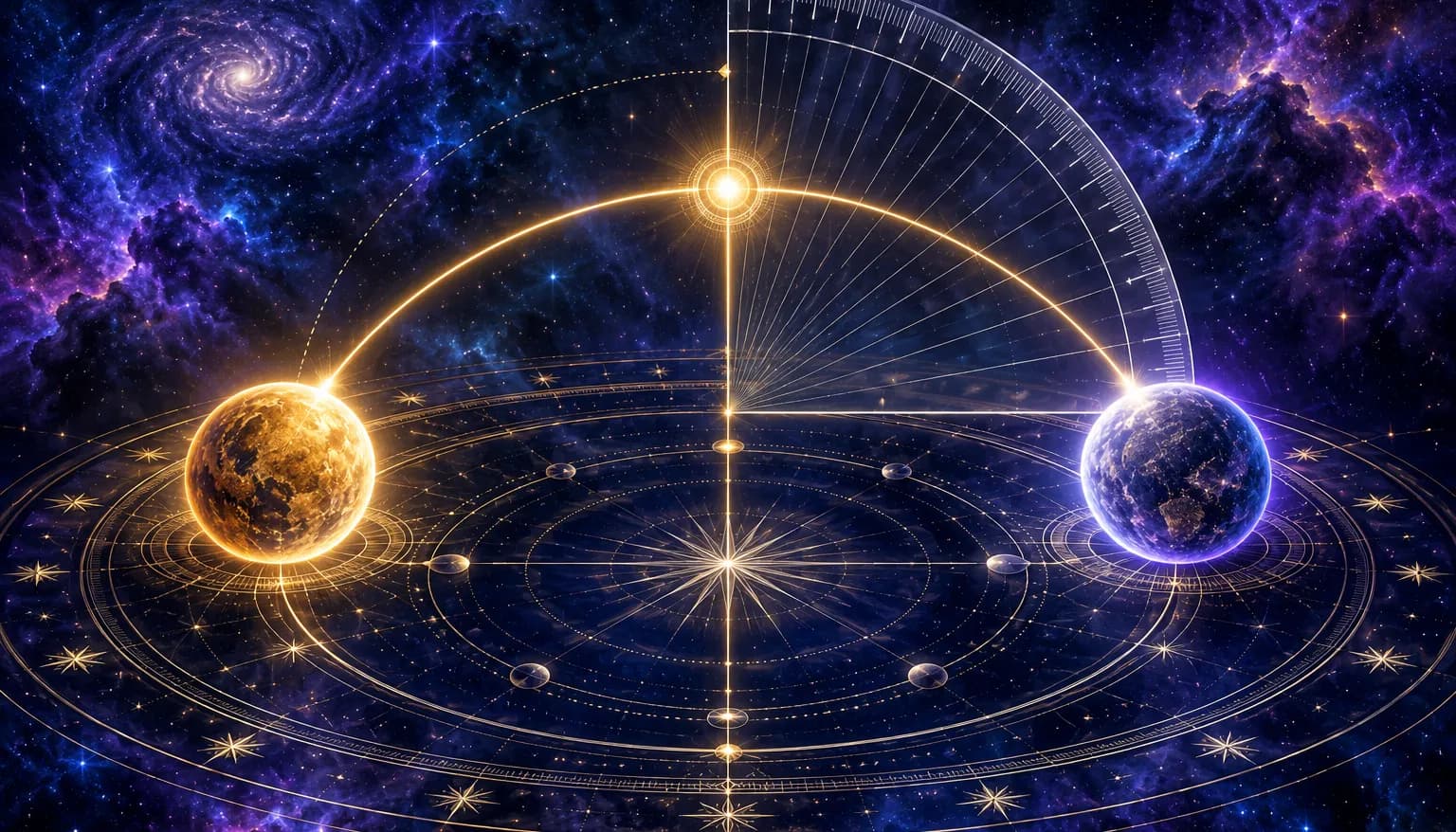
When we look at a birth chart, we usually focus on the planets, signs, houses and aspects. But there is a technique that looks at the space between the planets and can reveal very subtle nuances: midpoints. A midpoint is the exact degree halfway between two planets, and it is considered a sensitive point that blends the energy of both. At Aspectados we explain what midpoints are, where they come from, how to calculate them and how to interpret them in your birth chart and in transits.
What Midpoints Represent in Astrology
A midpoint is not a planet but a place in the zodiac where two forces meet symbolically. Its meaning includes:
- The synthesis of two planets: the Sun/Moon midpoint, for instance, blends conscious will with emotional needs.
- A sensitive point: when a natal or transiting planet occupies it, it activates the combination of both.
- Psychological detail: it reveals nuances that traditional aspects do not show.
- Timing precision: midpoints are widely used to time events with transits and directions.
- "Planetary pictures": the formula A/B = C describes how a third planet "completes" the pair.
Origins: The Hamburg School and Reinhold Ebertin
Midpoints have ancient precedents, but their modern systematization comes from the Hamburg School, formed around the German astrologer Alfred Witte in the early twentieth century. Witte and his followers developed Uranian astrology, which works with midpoints, symmetries and the 90° dial.
Later, Reinhold Ebertin streamlined the approach into what he called cosmobiology, setting aside many of the more speculative elements of the Uranian school. His book The Combination of Stellar Influences (originally published in German as Kombination der Gestirneinflüsse) became the standard reference: a dictionary of interpretations for every combination of planets and midpoints that many astrologers still consult today.
How to Calculate a Midpoint
The calculation is simple once you convert positions into absolute degrees (0° Aries = 0, 0° Taurus = 30, 0° Gemini = 60, and so on).
- Add the two positions together.
- Divide the result by two.
- Convert the number back into sign and degree.
Example: Sun at 10° Aries (10) and Moon at 20° Gemini (80). (10 + 80) / 2 = 45, that is, 15° Taurus. This is the near midpoint. The exact opposite point, 15° Scorpio, is the far midpoint, and it is also considered active.
Astrologers usually work with tight orbs, one to two degrees at most, because precision is the heart of this technique.
The 90° dial
The 90° dial compresses the 360° zodiac into a 90° circle. This way, conjunctions, squares and oppositions (and, in many approaches, semi-squares and sesquiquadrates) appear on top of each other. With the dial you can see at a glance which planets sit on the midpoint of others, even if they are in different signs. Today, astrology software handles this automatically.
The Most Important Midpoints
Sun/Moon
This is one of the most studied midpoints. It blends the conscious and the emotional, the symbolic masculine and feminine, and it is associated with relationships and inner harmony. Many astrologers check it in synastry: when another person's planet falls here, the bond often feels meaningful.
Venus/Mars
This is the midpoint of love and desire. It speaks of attraction, sexuality and how we combine tenderness with initiative. Planets on it color our love life: Jupiter can expand it, while Saturn can make it more serious or cautious.
Jupiter/Saturn
It joins expansion and structure. It relates to how we handle opportunities and limits, to career decisions and changes of direction. When activated by transit, it often coincides with times of life reorganization.
Mars/Saturn
A demanding midpoint: drive versus brakes. It is associated with sustained effort, frustration or discipline. Channeled well, it speaks of endurance and the ability to take on hard work.
Sun/Jupiter and Moon/Venus
Sun/Jupiter is linked to success, confidence and recognition. Moon/Venus is connected with tenderness, affection and emotional enjoyment. Many astrologers check these points to identify favorable moments.
Mercury/Jupiter
It combines mind and expansion: intellectual optimism, good news, negotiations and learning. When activated by transit, it often coincides with contracts, publications or study plans.
Ascendant/MC
This is a very personal midpoint, because it combines how you present yourself to the world (Ascendant) with your direction and vocation (Midheaven). Ebertin and other cosmobiologists treated it as a sort of "personal point" in the chart. Because it depends on the exact angles, it requires an accurate birth time: an error of a few minutes can move it noticeably.
Saturn/Pluto
A heavy, intense midpoint that astrologers associate with endurance under pressure, deep restructuring and the ability to persevere through difficult circumstances. When a personal planet sits on it or a transit triggers it, the themes tend to be serious, but they can also mark a period of great inner strength and lasting change.
How to Use Midpoints in Your Chart and in Transits
- Start with the personal planets: look for natal planets sitting on the Sun/Moon or Venus/Mars midpoints, or on the Ascendant/MC midpoint.
- Read the full formula: if Saturn sits on your Sun/Moon midpoint, the picture Sun/Moon = Saturn speaks of a serious relationship or family responsibilities.
- Watch the slow transits: when Jupiter, Saturn or Pluto touch a natal midpoint, the combined themes are activated for weeks or months.
- Use tight orbs: going beyond two degrees dilutes the meaning.
- Keep the big picture: midpoints refine interpretation, but they do not replace reading signs, houses and aspects.
Conclusion
Midpoints are one of the most precise techniques in modern astrology. Thanks to Alfred Witte's Hamburg School and the work of Reinhold Ebertin, we can now look at what happens between the planets and uncover nuances that classical aspects do not reveal. If you want to explore your birth chart in depth and receive personalized interpretations of your planets, aspects and transits, calculate your chart at Aspectados, the AI-powered astrology platform.